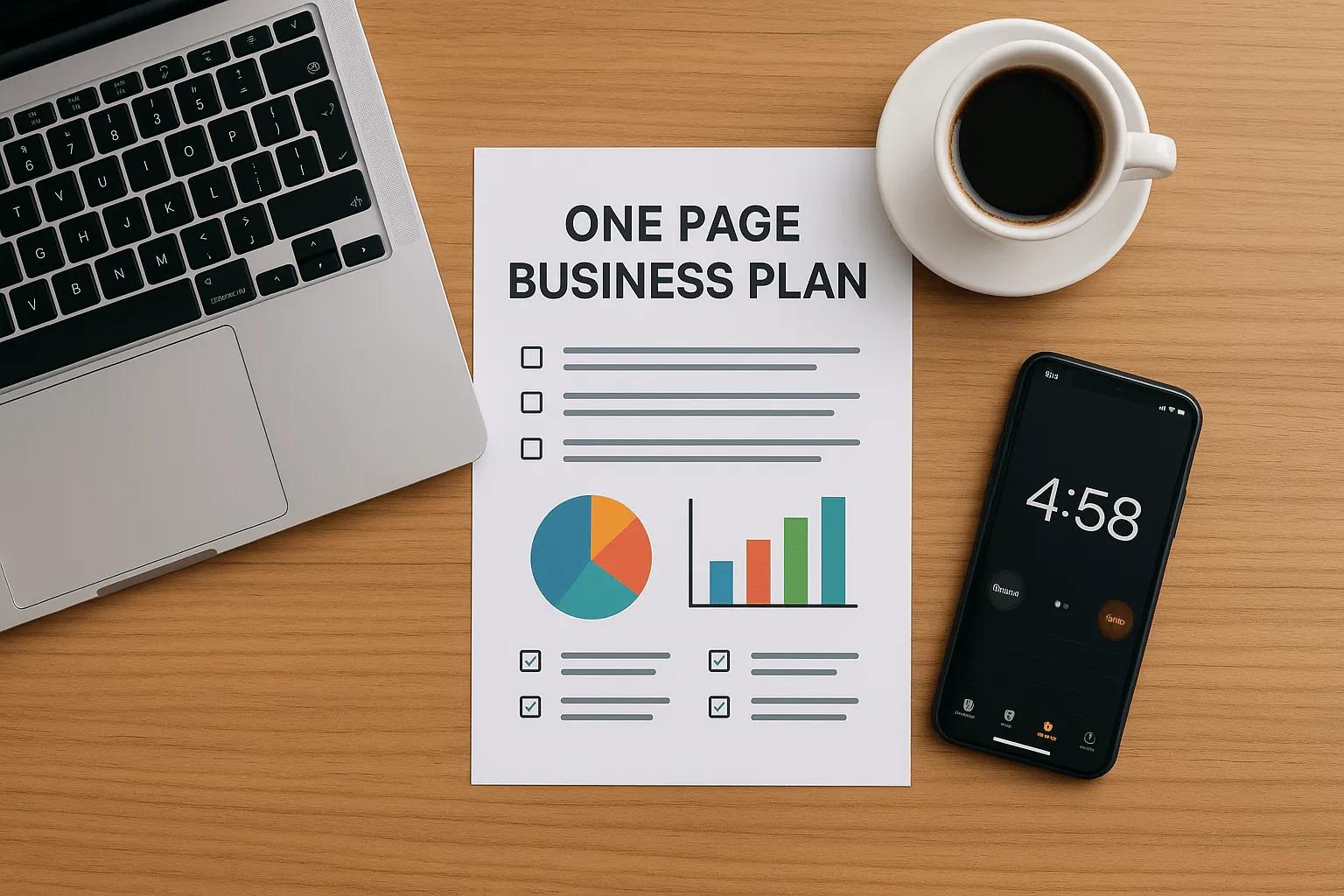
One Page Business Plan Template: A Simple Guide for Startups
Starting a business can feel overwhelming when you have dozens of decisions to make and no clear plan to follow. A one page business plan template helps you organize your most important ideas in one place, from the problem your business solves to the customers you want to reach and the money you expect to earn.
Unlike a lengthy traditional business plan, a one-page plan focuses on the essentials. It gives you a practical starting point for evaluating an idea, setting priorities, discussing your strategy with a partner, or preparing for a more detailed planning process.
In this guide, you’ll find a free fill-in template, a completed example, and practical tips for creating a useful plan for your small business.
What Is a One Page Business Plan?
A one-page business plan is a concise document that summarizes your business model, target market, products or services, marketing strategy, operations, and financial goals.
It is designed to answer a few essential questions:
- What does your business offer?
- Who are your ideal customers?
- What problem does your product or service solve?
- How will customers discover and buy from you?
- What will it cost to operate the business?
- How will the business generate revenue?
- What are your next steps?
A one-page plan is particularly useful when you’re developing an early-stage idea or running a relatively straightforward business. It can also help an established business review its priorities.
The U.S. Small Business Administration (SBA) explains that lean startup plans summarize key business elements in a concise format and may fit on a single page. However, a one-page document is not a substitute for every detailed plan a lender, investor, or business partner might request.
Free One Page Business Plan Template
Copy the following outline into Microsoft Word, Google Docs, or another document editor. Replace the bracketed prompts with information about your business.
1. Business Overview
Business name: [Enter your business name]
Business location: [City, state, or service area]
Business type: [Online store, consulting service, local business, or another model]
Mission statement: [Explain what your business does and why it exists in one or two sentences.]
Business goals: [List your most important short-term and long-term objectives.]
2. Customer Problem and Solution
Problem: [What challenge or unmet need do your customers have?]
Your solution: [Explain how your product or service addresses that problem.]
Unique value proposition: [Why should customers consider your offer instead of available alternatives?]
Focus on a specific customer need rather than making broad claims about being the best or cheapest business.
3. Target Market
Ideal customers: [Describe the people or businesses most likely to buy from you.]
Location: [Identify your geographic market, if relevant.]
Customer needs: [What do customers value most when choosing a solution?]
Competitors and alternatives: [Name relevant competitors or other ways customers solve the problem.]
Competitive advantage: [Explain the realistic differences that make your offer useful.]
4. Products or Services
Main offer: [Describe what you sell.]
Customer benefit: [Explain the outcome or value customers receive.]
Pricing approach: [Describe your planned prices or pricing method.]
Delivery method: [Explain how customers receive the product or service.]
5. Marketing and Sales Strategy
Customer acquisition channels: [Choose relevant channels such as local search, SEO, social media, email, referrals, or partnerships.]
Sales process: [Explain how a potential customer becomes a paying customer.]
Marketing budget: [Enter your estimated monthly or launch budget, if known.]
Success measures: [Choose practical measures such as qualified inquiries, conversion rate, repeat purchases, or sales.]
6. Operations and Management
Daily operations: [Describe the main tasks required to run the business.]
People and responsibilities: [Identify who manages sales, delivery, customer support, and finances.]
Equipment and tools: [List essential software, equipment, inventory, or suppliers.]
Legal and administrative needs: [Identify applicable registration, licensing, insurance, tax, or permit requirements to research.]
7. Financial Summary
Estimated startup costs: $[Amount]
Expected monthly revenue: $[Amount]
Expected monthly expenses: $[Amount]
Estimated monthly profit or loss: $[Amount, after accounting for expenses]
Funding needed: $[Amount, if applicable]
Financial assumptions: [Explain how you estimated prices, sales, expenses, and funding requirements.]
These numbers should be based on research, supplier quotes, and realistic assumptions wherever possible. If an amount is unknown, mark it as an estimate to be researched instead of presenting it as a confirmed figure.
8. Goals and Next Steps
First milestone: [What must happen first?]
Target date: [Enter a realistic date.]
Next milestone: [Describe the next important task.]
Main risk: [Identify a challenge that could affect your plans.]
Risk-reduction action: [Explain what you will do to prepare.]
This section turns your business plan into an actionable working document.
One Page Business Plan Example
The following example uses a fictional business. Its details are illustrative and should not be treated as verified market research or a financial forecast.
Imagine that an entrepreneur wants to launch a small online business selling reusable office and desk accessories.
| Section | Example |
|---|---|
| Business overview | DeskWise Online, a proposed e-commerce store |
| Customer problem | Remote workers want practical, organized workspaces |
| Solution | Sell selected desk accessories and workspace organization products |
| Target market | Remote professionals and home-office users |
| Value proposition | Curated products, clear product information, and convenient online ordering |
| Marketing | Search-focused content, social media, email, and customer referrals |
| Operations | Online storefront, supplier coordination, order fulfillment, and customer support |
| Startup costs | Research website, inventory, packaging, marketing, and business setup costs |
| Revenue model | Retail sales with revenue earned from product purchases |
| First milestone | Validate customer interest and compare supplier options |
Before investing heavily, the founder would research competitors, test demand, confirm product costs, and estimate shipping, returns, payment-processing fees, and marketing expenses.
The goal is not to make the business look successful on paper. It is to identify what needs to be true for the business to work and determine how to test those assumptions.
How to Create a One Page Business Plan in 6 Steps
Step 1: Define the Purpose of Your Plan
Decide what you need the plan to accomplish. You might want to evaluate a business idea, organize a launch, communicate with a partner, or prepare for a funding conversation.
Your purpose determines which details deserve the most attention.
Step 2: Research Your Target Customers
Identify who is most likely to need your product or service. Research their problems, purchasing preferences, budget, location, and current alternatives.
The SBA’s market research and competitive analysis guidance is a useful starting point for U.S. entrepreneurs. Where possible, support your assumptions with customer interviews, surveys, competitor research, and credible industry information.
Step 3: Explain Your Offer Clearly
Describe what you sell, who benefits from it, and why a customer might choose it. Avoid vague statements such as “we provide excellent service.” Explain what makes your offer relevant to a specific customer.
A clear value proposition makes the rest of the plan easier to understand.
Step 4: Choose Practical Marketing Channels
Select marketing channels that fit your customers and available resources. A local service business may prioritize local search visibility and referrals, while an online store may use SEO, email, social media, and partnerships.
You do not need to use every marketing channel at once. Identify the most promising options, set measurable goals, and review the results.
Step 5: Estimate Costs and Revenue
List your one-time startup expenses and recurring operating costs. Depending on the business, these may include equipment, inventory, software, insurance, rent, shipping, professional services, and marketing.
Then estimate revenue using a transparent method. For example:
Estimated monthly revenue = expected monthly sales × average revenue per sale
This calculation estimates revenue, not profit. You must also account for product costs, operating expenses, taxes, and cash-flow timing.
If your estimates are uncertain, develop conservative, expected, and optimistic scenarios rather than relying on one unsupported prediction.
Step 6: Review and Update the Plan
Read your plan as if you were an unfamiliar customer, partner, or adviser. Can you understand what the business sells, who it serves, how it plans to earn money, and what needs to happen next?
Update the plan when you learn more about customer demand, pricing, costs, or business performance. A one-page plan is most useful when it reflects current information rather than assumptions you never revisit.
One Page vs. Traditional Business Plan
A one-page business plan is not right for every situation. Choose the format based on your needs and the requirements of anyone who will review it.
| Feature | One-page plan | Traditional plan |
|---|---|---|
| Length | Condensed overview | Multiple pages with supporting detail |
| Best use | Early-stage planning and quick reviews | Detailed operations, financing, and strategic planning |
| Market research | Key findings summarized | More extensive analysis |
| Financial information | Main estimates and assumptions | Detailed projections and supporting schedules |
| Updating | Easy to revise frequently | May require more time to update |
| External requirements | May be insufficient for some applications | Often better suited to detailed reviews |
If you’re preparing to seek financing, review the lender’s specific instructions before choosing a format. Some applications may require detailed financial statements, cash-flow projections, supporting documents, or a full business plan.
For more guidance, see our article on business plan format and our guide to a startup business plan template.
Common Mistakes to Avoid
Even a short business plan can be misleading if its assumptions are weak. Watch for these common problems:
- Trying to serve everyone: Define a specific initial customer group.
- Ignoring competitors: Research alternative products, services, and customer solutions.
- Using unsupported financial estimates: Document the sources and assumptions behind your numbers.
- Confusing revenue with profit: Subtract relevant expenses before estimating profitability.
- Choosing too many marketing channels: Prioritize channels you can realistically manage.
- Leaving out risks: Identify likely obstacles and ways to reduce their impact.
- Making the plan too vague: Replace general goals with specific actions and measurable milestones.
- Never reviewing it: Update the plan as your business develops.
A short plan should encourage clear thinking, not hide uncertainty behind polished language.
Where to Find More Business Planning Resources
You can use the template above as your own starting point or explore established U.S. small-business resources:
- U.S. Small Business Administration: Visit the SBA business planning guide for guidance on market research, business plans, startup costs, and other planning topics.
- SBA sample business plans: Review the sample business plans to understand how a more detailed plan may be structured.
- SCORE: Browse SCORE’s business resources and templates for planning tools and mentoring resources.
If your business plan includes a funding requirement, our guide to business startup loan options can help you explore financing approaches. Eligibility and requirements vary by lender and funding program, so verify the details before applying.
Frequently Asked Questions
What should a one page business plan include?
It should summarize your business concept, customer problem, target market, products or services, marketing approach, operations, financial assumptions, and next steps. Adapt the sections to your business model and purpose.
Is a one-page business plan enough to start a business?
It can be a useful starting point for organizing an idea and setting priorities. You may still need separate research, financial worksheets, legal and licensing checks, and operational plans before launching.
Can I use a one page business plan template for a small business?
Yes. A small business can use a one-page plan to summarize its customers, services, marketing, expenses, revenue model, and goals. The details should reflect the business’s actual needs.
Can I use this template to apply for a business loan?
You can use it to organize your initial ideas, but do not assume it meets a lender’s requirements. Ask the lender what plan format, financial projections, documents, and application details are required.
Is a lean business plan the same as a one-page business plan?
They are closely related, but the terms are not always identical. A lean plan focuses on the essential parts of a business model and can often fit on one page. A one-page plan is a length-based summary that may use a variety of structures.
How often should I update my business plan?
Review it when important assumptions change, such as pricing, customer demand, costs, marketing results, or business goals. A regular review schedule can help keep your plan relevant.
Final Thoughts
A one-page business plan gives you a straightforward way to turn a business idea into a set of practical decisions. By defining your customers, explaining your offer, choosing realistic marketing activities, and documenting financial assumptions, you can identify what to do next without getting lost in unnecessary detail.
Start with the free template, research the parts you do not yet know, and set a few measurable milestones. As your business grows or your needs become more complex, expand the document into a more detailed plan.
The best plan is not the one with the most impressive wording. It is the one that helps you make better decisions and adapt as you learn.
1 thought on “One Page Business Plan Template: Free, Simple Guide”