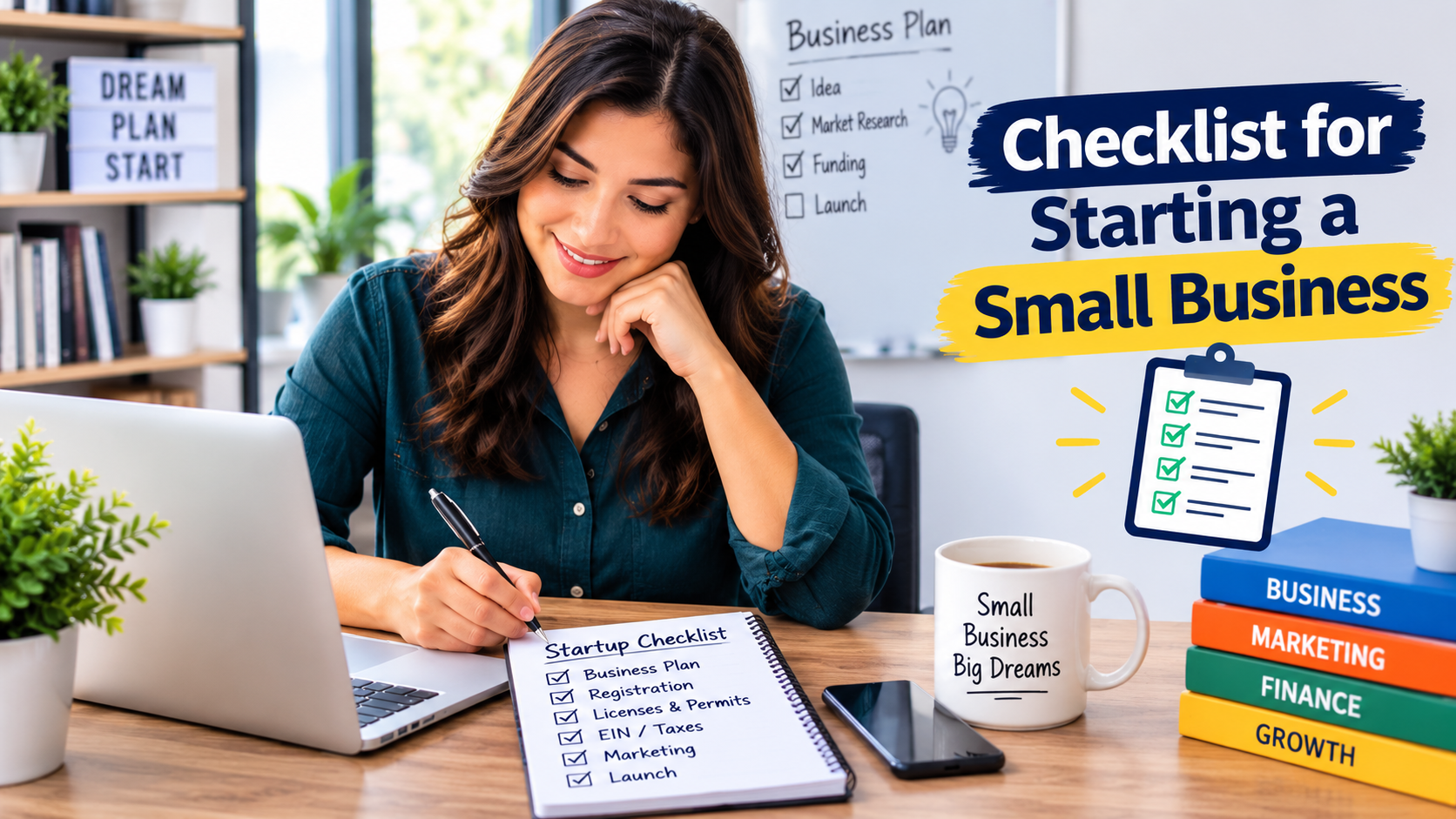
Checklist for Starting a Small Business: 15 Essential Steps
Starting a small business can be exciting, but turning an idea into a real business takes more than choosing a name and finding customers. You also need to understand your market, estimate your startup costs, choose a business structure, complete any required registrations, and prepare for taxes and daily operations.
This checklist for starting small business activities in the United States will help you organize the process into manageable steps. Whether you want to open a local service company, launch an online store, work as a freelancer, or start a home-based business, you can use these steps to build a practical launch plan.
Requirements vary by state, city, industry, and business structure, so treat this checklist as a starting point rather than a complete list of legal obligations.
Why Do You Need a Small Business Startup Checklist?
A startup checklist helps you identify what needs to be done before you begin operating. Without a plan, you might overlook an important permit, underestimate your expenses, or spend money on equipment before confirming that customers want your product or service.
A checklist can help you:
- Organize business setup tasks in a logical order.
- Estimate how much money you need to launch.
- Identify registration, licensing, and tax requirements.
- Prepare to manage business income and expenses.
- Track your progress before opening to customers.
You do not need to complete every task on the same day. Start with research and planning, then move through the legal, financial, and operational steps that apply to your business.
Checklist for Starting a Small Business: 15 Essential Steps
Use the following checklist to plan your launch. Some steps may need to happen in a different order depending on your business structure and location.
1. Choose and Validate Your Business Idea
Begin by defining what your business will sell and who is likely to buy it.
Ask yourself:
- What problem will my product or service solve?
- Who is my ideal customer?
- Why would customers choose my business over an alternative?
- How will the business earn revenue?
- Can I deliver the product or service at a sustainable cost?
Next, research your target market. Look at competitors, customer reviews, local demand, pricing, and gaps in the products or services available.
For example, if you plan to start a residential cleaning company, investigate the types of cleaning customers request, the services local competitors offer, and the costs of supplies, transportation, and insurance.
You can also interview potential customers or test demand with a small pilot service before committing to major expenses.
Checklist:
-
Define your product or service.
-
Identify your target customer.
-
Research competitors and demand.
-
Test whether potential customers are willing to pay.
2. Write a Simple Business Plan
A business plan explains how your company will operate, attract customers, and generate revenue. It does not have to be lengthy to be useful.
Include these essential sections:
- Business overview: What you sell and what makes your business different.
- Target market: Who your customers are and what they need.
- Products or services: What you will offer and how you will price it.
- Marketing strategy: How customers will discover and purchase from you.
- Operating plan: The equipment, suppliers, people, and processes you need.
- Financial plan: Startup expenses, expected revenue, ongoing costs, and cash flow.
Use realistic assumptions. For example, estimate how many customers you could reasonably serve each month instead of assuming that every interested person will make a purchase.
If you need a structured format, read our related guide, Startup Business Plan Template: A Practical Guide, on BusinessBring.com.
Checklist:
-
Describe your business model.
-
Identify your target market.
-
Outline your marketing and operating plans.
-
Estimate startup costs and future expenses.
-
Review your assumptions before investing heavily.
3. Estimate Your Startup Costs
Before spending money, calculate how much it will cost to open and operate your business.
Common startup expenses include:
| Expense category | Examples |
|---|---|
| Registration and legal costs | Formation filings, professional advice |
| Licenses and permits | Required state or local approvals |
| Equipment and supplies | Computers, tools, inventory |
| Website and marketing | Domain, website, advertising |
| Workspace | Rent, utilities, home-office setup |
| Insurance | Coverage appropriate to your operations |
| Professional services | Accounting, bookkeeping, consulting |
| Working capital | Cash for ongoing bills and unexpected expenses |
Separate one-time expenses from recurring monthly costs. A website may involve an initial setup expense and a continuing hosting fee. Inventory may require an initial purchase and regular replenishment.
Build a cash-flow estimate that accounts for the possibility that sales will take longer than expected to develop.
The U.S. Small Business Administration offers guidance on calculating startup costs and preparing for funding. Review its business planning resources.
Checklist:
-
List one-time startup expenses.
-
Estimate recurring monthly costs.
-
Calculate your initial cash requirement.
-
Set aside a reasonable contingency if possible.
-
Identify how you will fund the business.
Startup Business Plan Template: 7 Easy Steps
4. Choose a Business Name
Choose a name that is easy to understand, remember, and associate with your products or services.
Before committing to a name, check whether it is already being used by another business. Depending on your plans, you may need to investigate state business-name records, domain availability, social media usernames, and existing trademarks.
Remember that registering a business name with a state does not automatically give you exclusive trademark rights throughout the United States.
If you plan to operate under a name different from your legal name, check whether your state or local government requires a fictitious name, assumed name, or DBA filing.
Checklist:
-
Create a shortlist of business names.
-
Check relevant state business records.
-
Search for potential trademark conflicts.
-
Check domain and social media availability.
-
Determine whether a DBA filing is required.
5. Select the Right Business Structure
Your business structure affects taxes, paperwork, ownership, and personal liability.
Common structures in the United States include:
Sole proprietorship: Often a straightforward option for an individual operating a business without forming a separate legal entity. The owner generally remains personally responsible for business obligations.
Partnership: May suit two or more people operating a business together. The responsibilities and liabilities depend on the partnership type and applicable law.
Limited liability company (LLC): An LLC can provide liability protection in many circumstances, subject to legal limitations and proper operation. Tax treatment depends on applicable rules and elections.
Corporation: A corporation is a separate legal entity with formal organizational requirements. It may be suitable for businesses with particular ownership, investment, or growth plans.
There is no single best structure for every entrepreneur. Compare formation costs, annual filing obligations, tax implications, ownership arrangements, and liability considerations.
The SBA’s business structure guide explains the main options. Consider consulting a qualified attorney or tax professional when the choice has significant legal or tax consequences.
Checklist:
-
Compare the available business structures.
-
Consider liability, taxes, and administrative costs.
-
Discuss complicated situations with a professional.
-
Decide which structure fits your business.
6. Register Your Business Where Required
Once you have chosen a structure and name, determine which registrations apply.
Many LLCs and corporations must register with the appropriate state agency. Sole proprietors may have fewer formation requirements, although local registrations, DBA filings, and industry-specific rules can still apply.
Your business location matters. A business operating from home may face zoning restrictions, while a business serving customers in several states may need to investigate additional obligations.
Use your state’s official business registration website to confirm filing procedures, current fees, and deadlines.
Checklist:
-
Identify the relevant state registration authority.
-
Complete required formation or registration filings.
-
Check DBA requirements, if applicable.
-
Save confirmation documents and filing receipts.
-
Record annual report or renewal deadlines.
7. Obtain an EIN if Your Business Needs One
An Employer Identification Number (EIN) is a federal tax identification number issued by the Internal Revenue Service.
An EIN is required for many businesses, including partnerships, corporations, and businesses with employees, subject to IRS rules and exceptions. Some businesses that are not required to obtain one for federal tax purposes may still choose to apply for banking or state tax purposes.
If you are forming an LLC, partnership, or corporation, check the required formation sequence before applying. The IRS advises forming the legal entity first when applicable.
Applying directly through the IRS is free. Avoid third-party websites that charge a fee simply to submit an EIN application.
Start with the official IRS EIN application and guidance.
Checklist:
-
Determine whether an EIN is required or useful.
-
Complete any required entity formation first.
-
Apply through the official IRS website.
-
Store the EIN confirmation securely.
8. Check Federal, State, and Local Licenses and Permits
Licensing requirements depend on what you do and where you operate. Some businesses need only a few local approvals, while regulated industries may require specialized licenses.
Requirements may apply to restaurants, construction businesses, childcare providers, transportation companies, professional services, and other activities.
If you operate from home, check zoning rules, lease restrictions, and any home-occupation requirements that apply.
Do not assume that registering an LLC automatically authorizes you to conduct every type of business.
Use the SBA’s licenses and permits guidance and confirm the actual requirements with the relevant government agencies.
Checklist:
-
Check federal licensing requirements, if applicable.
-
Review state and local permit rules.
-
Verify zoning and home-business restrictions.
-
Confirm industry-specific requirements.
-
Track expiration and renewal dates.
9. Understand Your Federal and State Tax Obligations
Tax responsibilities depend on your business structure, activities, employees, location, and other circumstances.
Possible obligations include federal income tax, self-employment tax, employment taxes, state income taxes, sales tax, and local business taxes. Not every business is subject to every tax.
If you sell taxable goods or services, determine whether you must register to collect and remit sales tax in the relevant jurisdiction.
Keep business records from the beginning. Save invoices, receipts, bank statements, payroll records, and supporting documents for deductible expenses and tax reporting.
Consider working with a qualified tax professional if you are unsure which taxes apply or when payments and returns are due.
The IRS provides a checklist for starting a business and additional small-business tax resources.
Checklist:
-
Identify applicable federal taxes.
-
Check state and local tax requirements.
-
Determine whether sales tax registration is necessary.
-
Learn the relevant filing and payment deadlines.
-
Establish a recordkeeping system.
10. Open a Business Bank Account
Separating business and personal money makes bookkeeping easier and helps you monitor business performance.
Depending on your structure and banking provider, you may need an EIN or other tax identification information, formation documents, identification, and business licenses.
Compare account fees, minimum balances, transaction limits, cash-deposit rules, and available online banking features before choosing an account.
Use the account for business income and expenses rather than mixing personal purchases with company transactions. This is particularly important for maintaining clear records and respecting the separation between an LLC or corporation and its owners.
Checklist:
-
Compare business checking accounts.
-
Confirm the documents required by the bank.
-
Open the appropriate account.
-
Route business income and expenses through it.
-
Reconcile transactions regularly.
11. Set Up Bookkeeping and Financial Tracking
Bookkeeping helps you understand whether your business is generating enough revenue to cover its expenses.
Choose a recordkeeping method that suits the complexity of your operations. A simple spreadsheet may work initially for some businesses, while others may benefit from accounting software or professional bookkeeping support.
Track at least:
- Sales and other business income.
- Operating expenses and supplier payments.
- Invoices and customer payments.
- Inventory, where relevant.
- Payroll and tax records, if applicable.
- Cash available for upcoming bills.
Review your income and expenses regularly. Revenue alone does not tell you whether a business is profitable, because you must also account for the cost of delivering products or services and other operating expenses.
Checklist:
-
Choose a bookkeeping system.
-
Establish categories for income and expenses.
-
Save receipts and supporting documents.
-
Create a routine for reviewing transactions.
-
Monitor cash flow and unpaid invoices.
12. Review Business Insurance Needs
Insurance can help manage financial risks, but the appropriate coverage depends on your business and location.
Possible policies include general liability, professional liability, commercial property, commercial auto, cyber insurance, and workers’ compensation coverage where required.
For example, a cleaning company may need to consider property damage and liability risks, while an online consultant may need to review professional liability and cyber risks.
Some insurance obligations are set by law, and requirements differ among states and business situations. An LLC does not replace the need to assess insurance risks.
Compare policy limits, exclusions, deductibles, and premiums. Ask a licensed insurance professional which coverage fits your operations.
Checklist:
-
Identify the main risks in your business.
-
Check legally required coverage.
-
Compare relevant policies and exclusions.
-
Review coverage as the business grows.
13. Build a Website and Marketing Plan
Customers need a practical way to discover your business, understand your offer, and contact you.
Your marketing approach may include a website, a business profile on relevant directories, social media, email marketing, local networking, referrals, or paid advertising.
Start by identifying where your target customers look for solutions. A local repair service may benefit from local search visibility, while an online store may need product pages, search optimization, and customer email communications.
Make sure your website explains what you offer, whom you serve, how customers can contact you, and what the next step is. Use accurate claims, clear pricing where appropriate, and genuine customer reviews.
Set a small number of measurable goals, such as qualified inquiries, booked appointments, email sign-ups, or completed sales.
Checklist:
-
Create a professional online presence.
-
Explain your products or services clearly.
-
Choose suitable marketing channels.
-
Set a realistic marketing budget.
-
Track inquiries, sales, and customer feedback.
14. Prepare Your Operations and Customer Service
Before accepting regular orders, decide how your business will deliver its products or services consistently.
Your operating plan may cover suppliers, inventory, equipment, scheduling, shipping, customer communication, refunds, data protection, and quality control.
Write down the steps involved in completing a typical customer order. Identify who is responsible for each task, even if you are currently the only person working in the business.
If you hire employees, review applicable employment, payroll, workplace safety, and recordkeeping obligations before they begin work.
Test your process with a small number of customers where practical. Early feedback can help you identify problems before demand increases.
Checklist:
-
Prepare equipment and supplies.
-
Confirm supplier arrangements.
-
Establish customer communication procedures.
-
Document order fulfillment or service delivery.
-
Review employee requirements if hiring.
15. Complete a Final Pre-Launch Review
Before opening, review your checklist and confirm that essential tasks are complete.
Ask yourself:
- Is the business idea supported by customer research?
- Have I prepared a realistic budget and cash-flow plan?
- Have I completed the required registrations?
- Have I confirmed which licenses and permits apply?
- Have I addressed tax and recordkeeping obligations?
- Is my business banking ready?
- Have I reviewed insurance needs?
- Can customers find me and purchase from me?
- Can I deliver the product or service reliably?
You do not need a perfect business on day one. You do need to understand your responsibilities, know how your business will operate, and have a plan for addressing problems.
Create a short launch schedule with deadlines for unfinished tasks. Separate legal or safety requirements that must be completed before operating from improvements that can reasonably wait.
Small Business Startup Checklist You Can Print
Use this condensed list to track your progress.
-
Validate the business idea.
-
Research customers and competitors.
-
Write a business plan.
-
Estimate startup and ongoing costs.
-
Choose and check the business name.
-
Select a business structure.
-
Complete required business registrations.
-
Obtain an EIN if applicable.
-
Check federal, state, and local licenses and permits.
-
Understand applicable taxes and deadlines.
-
Open a business bank account.
-
Set up bookkeeping and recordkeeping.
-
Review insurance requirements and risks.
-
Prepare your website and marketing strategy.
-
Test operations and customer service.
-
Complete a final pre-launch review.
This checklist is a general planning tool. Your business may require additional steps depending on the industry, location, and ownership structure.
Common Mistakes to Avoid When Starting a Small Business
Even careful entrepreneurs can overlook important details. Watch out for these common mistakes.
Spending too much before validating demand. Expensive equipment, inventory, and office space can create financial pressure before you know whether customers will buy. Test your offer and budget carefully.
Choosing a structure without understanding the consequences. Different structures have different legal, tax, and administrative implications. Compare them before registering.
Assuming every business has the same licensing requirements. Requirements can vary by industry and jurisdiction. Check official government sources for your specific activities and location.
Mixing personal and business finances. Separate accounts and consistent records make financial tracking and tax preparation easier.
Ignoring cash flow. A business may record sales but still lack enough cash to pay bills on time. Monitor when money comes in and when payments are due.
Relying on unverified tax or legal advice. Confirm important requirements with official government sources or qualified professionals rather than relying only on social media posts or general online articles.
Frequently Asked Questions
What is the first thing to do when starting a small business?
Start by defining your business idea and researching whether customers need and will pay for your product or service. Then develop a basic business plan and estimate startup costs before committing significant money.
What documents do I need to start a small business in the USA?
Depending on your situation, you may need formation or registration documents, an EIN, licenses or permits, tax registrations, banking documents, and industry-specific approvals. The exact requirements depend on your business structure, location, and activities.
Do I need an LLC to start a small business?
No. Some businesses operate as sole proprietorships, while others choose an LLC, partnership, or corporation. The right option depends on your liability concerns, tax situation, ownership plans, and administrative requirements.
Is an EIN required for every small business?
No. Federal EIN requirements depend on factors such as business structure, employees, and tax obligations. Some businesses that do not need an EIN for federal tax purposes may still obtain one for banking or state requirements. Check the current IRS guidance for your circumstances.
Do I need a business license to operate from home?
Possibly. Home-based businesses may be subject to local business licensing, zoning, home-occupation rules, lease restrictions, or industry-specific requirements. Verify the rules with the relevant state and local authorities.
How much money do I need to start a small business?
There is no single amount that applies to every business. Costs depend on the business model, equipment, inventory, location, staffing, licenses, insurance, and working capital needs. Prepare an itemized budget before deciding how much funding to obtain.
Can I start a small business while working full-time?
That may be possible, depending on your employment agreement, time commitments, industry, and applicable rules. Check for conflicts of interest or restrictions with your employer, and create a realistic schedule for operating the business.
What should I do immediately before launching?
Confirm that required registrations, permits, and other pre-opening obligations are complete. Review your finances, test your operating process, prepare customer communication, and make sure you can deliver what you promise.
Final Thoughts
Starting a small business is easier to manage when you break the process into clear, practical tasks. Research your market, prepare a business plan, calculate your costs, choose an appropriate structure, and verify the registrations and permits that apply to your situation.
Use this checklist for starting small business activities as a working document rather than a one-time read. Check off each completed step, record important deadlines, and revisit your plan as your business develops.
For additional guidance, use official resources from the U.S. Small Business Administration and the Internal Revenue Service. They provide information to help entrepreneurs understand business formation, compliance, and federal tax responsibilities.